Learn how forced appreciation and four income streams create predictable profits with every small apartment you own.
In the world of real estate investing, small apartments—those with five or more units—offer one of the most overlooked paths to wealth. As Lance Edwards explains, they allow for fast, predictable profit creation through something called forced appreciation.
This strategy begins with a simple formula: Value = Net Operating Income (NOI) ÷ Market Cap Rate
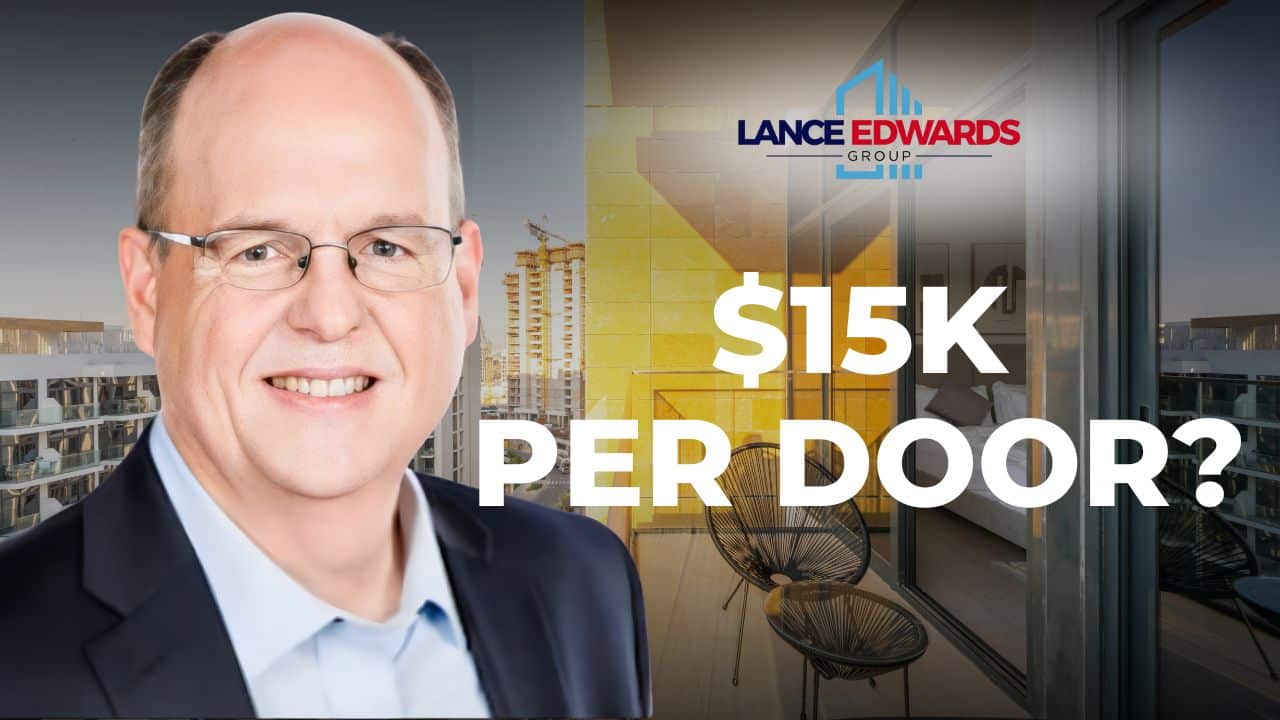
By increasing NOI—either through higher revenue or reduced expenses—you directly increase the property’s value. For example, a $100 monthly rent increase per unit can boost your property’s value by $15,000 per door. And yes, that’s just from one rent bump. This increase is not theoretical. A commercial appraiser can confirm that new value within 30 days, making this strategy as instant as it is predictable.
But that’s just the beginning.
Small apartments generate wealth in four powerful ways:
Forced Appreciation As NOI grows, so does the property’s value—automatically.
Residual Cash Flow With third-party management in place, higher rents translate to steady, monthly income.
Mortgage Pay Down Each rent check helps pay down your loan, building equity. Over five years, that can amount to six or even seven figures.
Massive Tax Deductions Property ownership provides generous write-offs, reducing your taxable income and letting you keep more of your earnings.
Combined, these strategies deliver a minimum of $20,000 net per door over five years. That’s $20K in true wealth for every apartment you own—cash flow, equity, appreciation, and tax savings included.
Do you want to know a way to both create wealth and protect it against inflation? Then you need to check out today’s Nugget, as I’m discussing Apartment Syndication and the process for syndicating your first 100 apartment doors. Whether you’re a first-timer or experienced in real estate, this Nugget is for you. Now is not the time for any of us to stick our head in the sand, hoping that inflation will just “go away”.
Number of Units: 3 building package (30 units total)
Personal Money Invested: 20% down payment
Prior Experience: Dr. Nfor, a cardiologist, had limited experience prior to Lance’s training. He had previously invested in 3 deals that worked out that he described as “okayish”.
Here’s his story:
As the father of four young children (three boys and one girl) ages 6 to 11, nothing matters more to Dr. Tonga Nfor than building a legacy for his family and amassing a substantial nest egg that includes a large college fund for the kids to draw from when the time comes. Over the past three years, even before reading Lance Edwards’ book “How To Make Big Money in Small Apartments” and enrolling in Lance’s boot camp, he began working on his goal by investing in real estate, with a focus on small apartments.
“I felt like that was an easier place to start accumulating wealth because I wouldn’t need a ton of capital to get going and in trying a new venture, it made sense to start small before working my way up to something bigger,” he says. I knew enough about investing in small family homes to realize that it wasn’t worth the amount of work I would have to put into it dealing with a single tenant at a time, especially compared to small apartments where you spread your risk over six, 10 or 15 tenants.”
As eager as he was to build a portfolio, Dr. Nfor’s extremely busy schedule as a cardiologist (specializing in cardiovascular disease and interventional cardiology) limited the amount of time the Milwaukee area physician could devote to this sideline passion. So his initial forays into small apartments were passive investing through other people and with a partner. He was part of a group that would pool their money to buy buildings, but was not directly involved in the purchases. Prior to discovering Lance’s book, he had invested in three deals that worked out, in his words, “okayish.”
Dr. Nfor was impressed by Lance’s way of breaking things down simply and the explaining the role of mindset in achieving one’s goals even before embarking on the math involved in doing a deal. He enrolled in a virtual boot camp during COVID – preferring the convenience and saving money and time compared to attending live – and, as a numbers person, took immediately to the crucial process of analyzing the figures quickly via the Doable Deal Generator to determine whether a deal will work or not. He also liked the boot camp’s quick immersion into finding and analyzing deals.
“It was also important to learn that I could generate and complete a deal all by myself,” he says. “Previously, I always assumed that I would have to go through an agent to be able to make an offer and close a deal. It was liberating also to know that I could negotiate directly with a seller, without any representation. By the time I left boot camp, I was already online looking for deals and analyzing them.”
In line with his desire to start investing in properties “in my own backyard,” the first deal Dr. Nfor closed on involved three small apartment complexes about 30 minutes from Milwaukee. Browsing realtor.com, he zeroed in on a 16-unit complex and reached out to the realtor. As they were discussing the numbers, the realtor revealed that the seller had two other buildings that he was considering selling that were not on the market yet. After some discussion, Dr. Nfor agreed to work on a package deal that would include smaller properties of six and eight units. All were “C class buildings,” meaning older structures that might need some upgrading, cosmetic work and repairs – but crunching the numbers, Dr. Nfor felt overall like the bundle was a solid deal that would generate good cash flow.
He made his close to full price offer during a boom time in the market when there was a lot of competition and many others showed interest in the original 16-unit property. The numbers were $600,000 for the 16-unit (down from the original asking price of $650,000), $350,000 for the eight-unit, and $250,000 for the six unit – for a total of $1.2 million. During inspection and due diligence, Dr. Nfor was informed of some repair issues with the roof and also cracks in the exterior of the eight unit, which led him to go back to the seller and seek a $30,000 price concession, which led to a renegotiation on that building to $320,000.
“At that point, the seller was very invested in having the deal for his three properties go through so he didn’t object to changing the selling price,” says Dr. Nfor, who closed on the properties in January 2021. “I know Lance extols the value of seller financing but this seller was not interested in that. He wanted cash to roll into another deal he had going, so I personally put up the down payment from money I had and was able to secure 80 percent via bank loan. This was fine for me because my primary purpose in making this deal is to build equity and value over time.”
By mid-year 2021, he had mostly positive things to report. In line with Lance’s teachings, he has found an efficient and reliable property management company to take care of the buildings and help with marketing efforts to draw good tenants to consider living on the properties – which has resulted in a current 90 percent occupancy. However, the enduring effects of the pandemic on rentals have resulted in a major cash flow challenge, which Dr. Nfor says, “no training or prep could prepare anyone for.”
One of the biggest overall problems, he says, was that the market during the pandemic was crazy, and hot properties were overpriced. A second issue – and one that had a major impact on him and his properties, was that some buildings had tenants who lost their income due to COVID and couldn’t pay rent. Yet because of a state moratorium, they couldn’t be evicted. Dr. Nfor is hopeful that when the moratoriums end, the rent collection challenge will disappear and over the next few months, everything will bounce back to the numbers he envisioned when I bought the properties.
“For a first time small apartment owner,” Dr. Nfor says, “this kind of issue can be quite discouraging, and I freaked out a little bit because of the prospect that I might lose money. During this time, my goal was to simply stay afloat, pay the mortgages and other bills and not worry about profit. But I am optimistic this will pass and everything will settle down. The main thing I have learned through the ups and downs of this process is to trust my gut and trust the numbers that the deal analyzer gave me. You can lean on your feelings and intuition, but ultimately it’s the numbers that should guide your decisions.
“I would urge anyone thinking of getting involved in small apartment investing to educate themselves, formulate a plan and then execute it to the best of your ability – understanding of course, that unexpected setbacks are part of the learning process along the way to success,” he . adds. “Once you have the baseline knowledge, it’s all about taking action. I feel like I have a strong vision for what I want to achieve and am excited to start building on the foundation I have in place.”
Profit Strategy: Rehab and Wholesale (using owner finance to their buyer!)
Number of Units: 20 units
Amount Earned: They estimate they’ll make $87k within 2 years
Prior Experience: Mary is a longtime real estate professional in Dallas, TX
Here’s their story:
A Certified Property Manager with nearly 40 years of experience in the multi-family realm, Mary Lindner has the distinction of being the only person who attended a Lance Edwards boot camp to do a wholesale and an owner finance of a property in the same deal. She and her husband and investment partner Paul had two essential requirements for their first deal: that the property be small and require a minimal down payment, and that it be in Texas because, as a longtime real estate professional in Dallas, Mary had easy access to Texas Association of Realtors form.
Paul found a suitable property in the border town of McAllen, some eight hours away, on Loopnet, and the couple reached out to the daughter of the owner, whose family had owned the ten unit single bedroom apartment building for 30 years without spending much time on upkeep and leaving the rent without increases. Checking comps in the area on Apartments.com, the Lindners learned that all the rents in the area were higher. The property also clearly needed some rehab work.
They also engaged in several of the strategies they learned from Lance, including using Google maps to start “driving the streets” around the property to make sure it’s a decent neighborhood. The property was very close to the bus line and close to buildings and businesses that were part of a downtown revitalization project. Mary raves about the success they had using Lance’s famed “Doable Deal Generator,” which she describes as “five year pro forma projection of income and expenses on the property. The beauty of this spreadsheet is that not only can you plug in actual numbers off the financials from the seller, you can also compare those to expenses you expect to incur.”
The McAllen property was listed at $280,000, and once the Lindners saw it was in a decent neighborhood they realized they could increase the rent, and once they did some rehab on things like faucets and fixtures, maintenance expenses would go down for the person they would be wholesaling it to. They negotiated the price down to $250,000.
“We had never done a wholesale deal before, but knew how it worked,” says Mary. “We put together the pro forma in the Doable Deal Generator, which came up with numbers for us in three different potential scenarios, an all cash deal, an owner finance deal and one that fell somewhere in between those two. Based on the numbers, which included the money we put into rehabbing the property, we marketed it like Lance told us. Someone found it on his website and contacted us. The prospective buyers knew that if they could buy with owner financing, they would be able to pay us more for it. We worked with our coach Hoku, and Lance helped us with some of the nitty gritty questions we had and helped us structure the deal.
“Ultimately we sold it for $330,000,” she adds, “and we got almost $10,000 at the closing table since we owner financed. We loaned the buyer $70,000 at 5% interest, and they are currently making monthly payments of $305 – with a balloon due in 23 months. By that time, we estimate that we will have made $87,000 on the deal. Our plan is to do wholesaling for a while to gain more capital for more permanent purchases down the road.”
Mary Lindner brings a dynamic background to her current endeavors as a multi-family investor. In the early 80s, she started out in as a leasing agent in multifamily property management, overseeing a 350 unit property. Over the years, she worked her way up to assistant manager of a 440 unit property, and then manager of huge properties ranging from 264 to 500 units. She later became a regional manager supervising eight apartment managers handling a total of over 2200 unites – and became one of the few women in the 90s to attend the Institute of Real Estate Management and receive a CPM. All of these experiences opened doors for her as far as learning the financial end of multi-family housing.
All told, Mary has been a realtor for over 30 years and became a broker six years ago. She and Paul became investors some years ago via their involvement with one of the local investment clubs in Dallas. Despite her background in managing apartments, their investments were limited to single family properties. Because they were focused on work and raising their children, they only had so much time to devote to these endeavors. Several years ago, she met Lance at an investor club meeting where he spoke.
“I really liked what he had to say, and quickly decided that if we were ever going to get into small apartment investing, he would be the person I wante to learn from,” she says. “He had made a lot of money for many investors and I knew he could help us do the same. Once the kids were out of the house, we knew it was time. We saw he was having a boot camp, and decided to sign up. Our March 2020 sessions were moved online because of the pandemic, but we still found them very informative. We also loved the fact that he and his staff are there to help us every step of the way.”
Like many families, The Lindners’ interest in investing in small apartments is legacy-related, based on their desire to leave something to their two children – which they adopted from Russia many years ago – and two grandsons. But their vision also extends beyond family to buying properties they can convert into specially equipped homes for disabled veterans and single parents struggling to get to the next phase of their lives.
“Many of our family members are in the military, and I feel sad when I hear things about disabled vets being forced to live in undesirable places because they have no other options,” Mary says. “It’s something I have been wanting to do for many years and now with small apartment investing, I see a path to do that. Just recently I took a course in this type of thing to learn more. We want to set things up where we would have a small apartment property and maybe a large house we could make modifications to for those in wheelchairs.
“Likewise, we’ve always had a vision to own a small apartment property as a place where single parents can live till they get back on their feet,” she adds. “We could help these single parents get schooling and learn how to interview for jobs. It would also be an opportunity to employ elderly people who could come and take care of the children as their parents go for interviews and start working. Sure, we would all like to have more money to live on, but we don’t have to be rich in the conventional way. Helping vets and single parents stay off the street and get back on their feet is a very worthwhile goal to us. With Lance’s help, we have laid a foundation to eventually achieve that goal and are currently looking for the right deals to take the next step.”
Orna and Gary are business partners and they flipped a fourplex (quadplex), a four unit small apartment building, earning $14,000, achieving this in 90 days
What you’ll learn in this episode:
*They started with small apartments about three years ago. First, they attended Ron Legrand seminars. They assumed the right path was graduating from single family homes to multi-family homes, but after reading Lance Edwards’ book, their attitude started to change. They were heavily involved in single family homes and wanted to see if that could work. They were doing this in Los Angeles and found it difficult because of the prices and other roadblocks.
*Another reason they made the switch to multi-family buildings is because it would be difficult to do a rehab on a single family house in another state without being there – having to trust people they didn’t really know to help them
*Orna moved to Los Angeles to be a filmmaker and entered real estate because the film industry is so volatile
*Gary feels that the main objective in doing multi family is having the ability to build income on a continuous basis rather than having to look for another property to flip all the time. You need a combination if you really want to do well. He doesn’t believe you can get rich just flipping properties
*They had their direct mail marketing done by Lance’s people. The person who responded to the postcard that led to their first deal called Gary’s office. He had a productive discussion with her and hearing the preliminary numbers as far as expenses and income led him to decide it was wise to make an offer. Their offer was accepted
*Orna and Gary sent the seller an LOI with the three offers. They chose the cash. There was a discussion about the $250 “door thing” and Gary was able to talk them into leading that into the contract. He considered it a very good deal. The title company did all the paperwork and Gary just received confirmation that it was going to close soon
*Orna thinks it’s good to have a partner. It can be scary doing everything by yourself when you’re embarking on something new. She likes the idea of splitting up duties with Gary and complementing each other’s strengths and weaknesses.
*She remembers their marketing started in mid-January and by mid-March Gary got the first call. The tag team concept worked perfectly, with Orna following up Gary’s call and getting more details. It’s a great way to build rapport with the seller or buyer.
*The purchase price was $150,000 minus the thousand dollars for the repair
*Gary says the property had a lot of plusses going for it, but admit they had considered offering less. Their starting offer was $150,0000 and the seller left it right there. The big plus was over $400 per door per month profit of cash flow. It had a master lease that would be in place for another year and a half that guarantees income even if the apartments are empty
*Gary admits they were teetering between buying the property and utilizing the income from it or selling it to provide a possible cushion moving forward
*Their buyer answered an ad on the Who’s It buyer generator. They did the buyer flyer, executive summary. They got 21 total responses
*A guy named Alex called Gary and made an immediate offer. They negotiated a bit and landed on what he and Orna were looking for a $15,000 profit. They wound up with $14,000 after a few days of negotiation. They had bought it for $150,000 and were asking $165,000
*The first offer was full price but they wanted Gary and Orna to pay $3500 towards their closing costs. Gary responded no. The buyers returned and said they didn’t realize that Gary and Orna were wholesaling, they thought they were the owners. The buyers’ counteroffer was worse than the first. They went from $3500 to $500 on the closing, with a purchase price of $164,000.
*Gary explained that the buyer was getting equity in the property and $400 per door per month cash flow
*An explanation of their work as a “tag team” and how they discuss and plan for different potential scenarios (including if the buyer pulled out of the deal) in the buying and selling processes
*The bank’s appraisal came back lower than what the bank was willing to lend compared to what the original amount they would lend to the buyer. It was $159,000 to $164,000
*The bank originally thought Gary and Orna were real estate agents
*Gary says the most important thing he’s learned is the importance of sticking with it. He believes you don’t fail until you give up. There are a lot of things to learn. He urges newcomers to the multi-family word to be patient and utilize any avenue you can to fill the gaps. He reads a lot about financing multi-family properties and how to work deals he doesn’t yet understand
*Orna says you need to have a good foundation on how things work and then keep the momentum going, reading articles and books as well as researching the marketing to see what’s going on in different places. Understanding trends is important, as is patience because everything happens step by step
*Mark has been doing real estate on and off for six years, recently deciding to take it more seriously and do it full time
*He found that with other mentors and seminars, he always left wanting more information. He found Lance’s boot camps to be one of the better ones. He believes if he had upgraded his mentorship, he would have gotten all of his residual questions answered
*He chose small apartments vs. single homes because of the bigger potential returns. If you have one unit and it doesn’t rent out, you’re losing money. With apartment buildings and multi-family you have a bunch of units, so you have better cash flow possibilities
*He found his deal on the net and contacted the realtor who had it listed. The list price was $420,000 and gave him the three offer LOI he learned from Ron Legrand in his boot camp. The seller would not owner finance at all. So he wouldn’t accept the offer. He countered at $382 after Mark submitted $360
*All communication was through the broker. Their negotiation process was very easy
*For $420,000, Mark put together the three offers and he accepted cash at $382,000 and then put together a buyer flyer and did the marketing through Lance Edwards
*He got it under contact with the realtor and submitted the contract to customer service and they told him to submit it with the flyer and a summary
*He got around ten calls from the flyers buyer generator, but everyone was asking for owner financing and he couldn’t make that work. He again tried to convince the owner to self-finance, but he would not
*Mark’s sale price was $399,000. He was aiming to profit $17-18,000
*Every potential buyer wanted financing and had no cash to worth with
*Mark put down $10,000 in earnest money
*He is moving on to the next deal, using Craigslist and Loopnet. He has since closed another deal in Branson, MO
*The most important thing he learned is how to calculate income and expenses. Also, post ad for property for sale. They always have like 15-20 percent expenses. With Lance’s program, they give you the formula and show you actually what it’s going to be. So even when you think you’re getting a deal, you’re not actually getting a deal. You can pretty much call out the seller right away. Another thing is you just have to stick with it and keep going.
Using Lance’s training and system, Ryan secured under contract two triplexes for $125,000 each, a total of $250,000. Lance’s organization marketed it for Ryan and found a buyer. There were some issues related to the inspection that caused the seller to back out of the original contract.
What you’ll learn in this episode:
*His family has been involved in real estate purchases mostly in California and Arizona, mostly single-family units
*When he learned about Lance’s small apartment program, he started thinking about how much better the number in buying and selling would be in other states
*He did the “plug and play” and he found this deal through one of the postcards about three or four months in
*He was presented with three triplexes in Indiana but rejected the third one because it was in bad condition and in a bad area. It was the seller’s decision to x out the third one from the deal because it needed too much work
*The owner was interested in selling so he could “go bigger” and find 10-15 unit buildings that he could invest in with friends
*In about two or three weeks, the owner and Ryan agreed on a number that worked for them. Ryan says, however, “we were not able to sell our financing because they wanted to get out and go big.”
*Ryan used one of Lance’s buyer flyers to help build his potential buyer list
*After the team made sure the summary Ryan created was legit, Ryan started marketing the property. In about two or three weeks, he started getting hits and found a very interested person
*It was nerve-wracking in the beginning with the buyer. The first person who called was from a buyer group that the Atlantis team had found, and it was a big investor who had hard questions Ryan couldn’t answer. He got good advice from Lance’s team but the potential buyer ultimately decided he didn’t want to buy in Indiana
*The second buyer was friendly and he and Ryan struck up an immediate rapport. He understood the numbers and had an additional unit down the street. He was excited but it was still nerve-wracking for Ryan since he was so new
*Ryan did a conference call with the seller and buyer. The seller was skeptical, but his objections were overcome and they signed up for inspection dates
*One of the two buildings was great, and the photos Ryan got in the beginning from the cellar and the ones the buyer received at the inspection date were the same. The other building, unfortunately, was “like a D-minus building.” The outside looked the same but the second was in horrible condition and was going to need such a huge overhaul that the deal as is no longer made sense
*The buyer backed out of the deal, and the seller cancelled the deal too, realizing how bad it was after never having really been in the building
*Ryan had only put down $100 on each complex before getting them under contract
*Despite the setback, Ryan liked the postcard method and the fact that the intake team did all the work on the front end. So when he called the seller he had all the answers. “It was as if I had a fellow employee call everything in there, with me as the boss, kind of verifying before giving him a deal number.”
*Realizing that the seller wasn’t completely honest about the bad building was an eye opener, but Ryan saw some positives in the process and says it helped him build his confidence
*He currently has five deals in the negotiating stages. He’s calling on postcards, trying to get seller financing, get terms and get the deals done
*The single most important thing he learned is that you need to work on this like it’s a math problem from school. You need a number of surefire things to call on and to inquire about or you won’t get far because you can’t just rely on a single deal. You have to have 15, 20 or 30 of them, and then they will start closing. It’s crucial to keep getting more in the pipeline.